
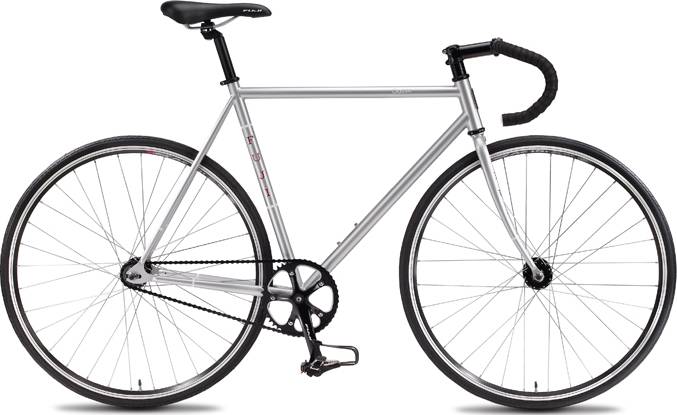
Bike details
Overview
Key information split into simple groups.
Bike summary
-
-
 Frame Steel
 -
 Wheels 700c
 -
 Suspension Rigid
 -
 Drivetrain Single Speed
 -
 Brakes Rim
Parts list
Components
Main components, grouped by system.
Bike components
Frame
Frame
Fuji Elios 2 custom butted CrMo with outer butted seat tube, Single water bottle mounts
Suspension Fork
Fuji 1 1/8" Custom Triple Butted CrMo, crown drilled for front brake
Drivetrain
Rear Derailleur
none
Front Derailleur
none
Shift Levers
none
Cassette
15T Fixed w/lockring
Crank
Fuji Forged Alloy Track Crank, 46T
Bottom Bracket
Sealed cartridge bearing ST
Chain
KMC Z-410
Wheels
Rims
Formula Alloy Track, 32H hubs, Jalco DRX-2000 Double Wall, 32H rims
Tires
Kenda, 700 X 25c
Brakes
Brakes
C-Star AS 2.4 Alloy Front and Rear
Brake Levers
Promax Top Mount Alloy
Cockpit
Stem
Fuji Pro forged Alloy
Handlebar
Fuji 6061 Butted Road, 26mm Anatomical Drops
Headset
Ritchey LB 1 1/8" Threadless
Seat
Saddle
Fuji Superlight Racing
Seatpost
Fuji Micro Adjust Alloy, 250x27.2mm
Fit data
Geometry
Numbers for sizing and ride feel.
| Size | XXS | XS | SM | MD | MD/LG | LG | XL |
|---|---|---|---|---|---|---|---|
| Stack Reach Ratio | 1.16 mm | 1.26 mm | 1.25 mm | 1.28 mm | 1.33 mm | 1.36 mm | 1.4 mm |
| Bottom Bracket Height | 280 mm | 282 mm | 282 mm | 282 mm | 282 mm | 282 mm | 282 mm |
| Front Center | 566 mm | 578 mm | 572 mm | 568 mm | 580 mm | 589 mm | 594 mm |
| Rake | 40 mm | 45 mm | 45 mm | 40 mm | 40 mm | 40 mm | 35 mm |
| Trail | 67 mm | 68 mm | 72 mm | 78 mm | 61 mm | 61 mm | 63 mm |
| Stack | 445 mm | 482.1 mm | 490.2 mm | 501.2 mm | 523.5 mm | 542.7 mm | 569.8 mm |
| Reach | 384.1 mm | 383.6 mm | 393.5 mm | 391.3 mm | 395 mm | 399.1 mm | 405.9 mm |
| Top Tube Length | 496 mm | 516 mm | 536 mm | 546 mm | 556 mm | 566 mm | 586 mm |
| Seat Tube Angle | 76 ° | 75 ° | 74 ° | 73 ° | 73 ° | 73 ° | 72.5 ° |
| Seat Tube Length | 430 mm | 490 mm | 520 mm | 540 mm | 560 mm | 580 mm | 610 mm |
| Head Tube Angle | 72 ° | 71.5 ° | 72.5 ° | 72.5 ° | 73.5 ° | 73.5 ° | 74 ° |
| Head Tube Length | 90 mm | 90 mm | 95 mm | 105 mm | 125 mm | 145 mm | 170 mm |
| Chainstay Length | 391 mm | 404 mm | 404 mm | 404 mm | 404 mm | 404 mm | 404 mm |
| Wheelbase | 954 mm | 975 mm | 968 mm | 964 mm | 976 mm | 986 mm | 991 mm |
| Bottom Bracket Drop | 33 mm | 58 mm | 58 mm | 58 mm | 58 mm | 58 mm | 58 mm |
| Standover Height | 693 mm | 735 mm | 751 mm | 771 mm | 787 mm | 806 mm | 833 mm |
| Wheels | 700 | 700 | 700 | 700 | 700 | 700 | 700 |
About this model
Classic Track (INTL) belongs to the Fuji Classic model. Fuji launched 11 bikes of this model so far. Take a sneak peek at all Fuji Classic bikes models from 2011, by clicking here.
Safety
When cycling always take safety very seriously. Wear a helmet, obey the traffic rules and wear hi-vis clothes. In short, take care of yourself so others can take care of you.
Track bikes average price
According to our math, the average price for a trustworthy Track bike is 1503$. However, paying less money than this amount doesn’t mean that you couldn’t get a great Track bike. In conclusion, always check bike reviews and their components before making a purchase to make sure you don’t overpay.
Track bikes average weight
On a deeper look, we notice that the average weight of a Track bike is 7.85 kg (17.31 lbs). You will have a greater advantage on climbs if your bike is easier than the average. On descents, however, a heavier bike will give you extra speed.
With a weight of 9.6 kg (21.16 lbs), Fuji bike is much heavier than average. In short, the average Track bike weight is 22.29% lower than this one.
Classic Track (INTL) components
Fork material
The fork on this bike is made out of steel, so, it can add some extra weight to your bike. However, steel is a pretty tough and durable material.
Wheels size
The Classic Track (INTL) 2011 bike is equipped with 700c aluminum wheels when leaving the factory. There is no doubt, that 700c wheels are very popular on all road bike models. However, while they give you great speed and control, these wheels are not so bump-friendly.
Brakes
When you want to stop the bike in time, the brakes are vital. The Classic Track (INTL) has Rim brakes. Rim brakes are cheaper than hydraulic brakes, and also easier to maintain. However, they are not nearly as effective as hydraulic brakes are.